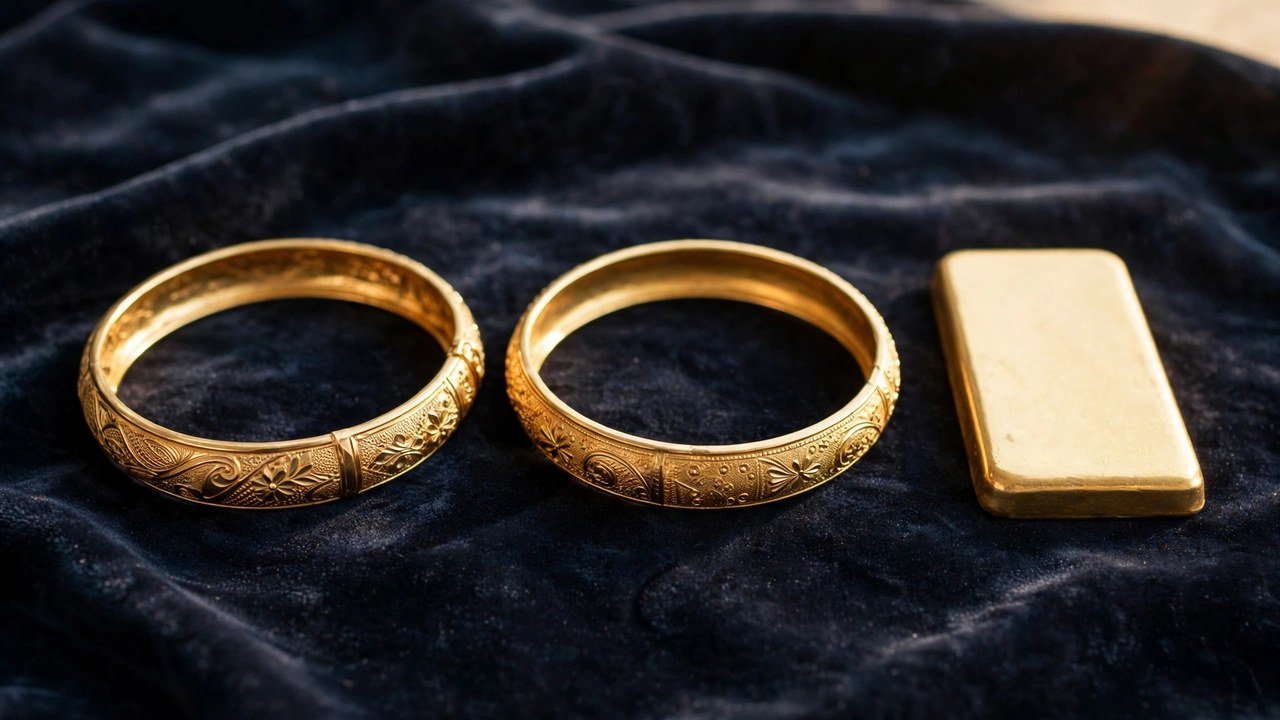
When you walk into a jewellery shop in Pakistan, you will hear two numbers again and again: 22 karat and 24 karat. Both are real gold, but they are not the same, and the right choice depends on how you plan to wear the piece. This guide explains the difference in simple words, so you can choose with confidence.
What Karat Really Means
Karat is a simple way to say how much pure gold is in a piece. Think of it in parts out of 24. A 24 karat piece is 24 parts gold out of 24, which means it is almost pure gold. A 22 karat piece is 22 parts gold out of 24, and the other two parts are another metal mixed in for strength.
In the purity system used by jewellers, 24 karat is marked 999, which means about 999 parts gold in 1,000. 22 karat is marked 916, which means about 916 parts gold in 1,000. The numbers sound technical, but the idea is simple: a higher karat means more pure gold, and a lower karat means a little more of another metal added for toughness.
24 Karat: Pure, Soft and Best for Saving
24 karat gold is beautiful and almost pure, but pure gold on its own is quite soft. It bends and scratches more easily than mixed gold. That is why 24 karat is usually used for bars and coins, rather than jewellery you wear every day.
If your main aim is saving, 24 karat bars and coins are the usual pick. They are easy to weigh, easy to check and easy to sell later, because their value is based almost entirely on the gold itself. Many families buy a small 24 karat bar or coin when they want to keep value over time, rather than wear it.
The trade-off is clear: 24 karat is the purest choice, but it is not the toughest choice. A thin 24 karat ring worn every day can lose its shape over time, and a delicate 24 karat chain can stretch. For a piece that will live in a drawer or a locker, that softness does not matter much. For a piece on your hand every day, it matters a lot.
22 Karat: The Traditional Favourite for Jewellery
22 karat gold is the favourite for traditional jewellery in Pakistan, and there is a good reason for it. It still has a very high gold share, but the small amount of other metal mixed in makes it stronger and better able to hold its shape. That is why most wedding sets, bangles and traditional rings are made in 22 karat.
For daily wear, 22 karat is usually the better balance. It looks rich, it holds its design well, and it can handle everyday use much better than pure gold. It will still need care, like any fine jewellery, but it will not bend or scratch as easily as 24 karat.
22 karat also has a practical advantage when you sell. Because it is the standard for traditional jewellery, most jewellers in Pakistan buy and sell it every day, and they know exactly how to test and value it. That makes the selling process smoother, especially if you have kept your receipt with the weight and karat written on it.
Price: Why 22 Karat Costs Less Per Gram
Because 22 karat has slightly less pure gold than 24 karat, it costs slightly less per gram for the gold value alone. The difference is not huge, but it is real. For a large piece, such as a heavy bridal set, the difference can add up to a noticeable amount.
Remember, though, that the final shop price is not just the gold value. Making charges, shop margins and taxes are added on top, and those can differ from shop to shop. A simple 22 karat band may cost less overall than a detailed 24 karat piece, not only because of the karat, but because of the work involved. Always ask for making charges separately, so you can compare fairly. You can work out the gold value for any weight and karat with the Gold Calculator, and check today’s rate on the homepage before you visit a shop.
Daily Wear: A Simple Way to Decide
Here is a simple way to think about it:
- For something you will wear every day, such as a ring, a bangle or a chain, 22 karat is usually the safer choice. It is strong enough for daily life and still rich in gold.
- For something special that you will wear only on occasions, such as a wedding set kept carefully, 22 karat is also the usual choice in Pakistan, because it holds detailed designs well.
- For saving or investment, where you do not plan to wear the gold at all, 24 karat bars and coins are the usual pick, because purity matters more than toughness.
- For modern, everyday jewellery with stones or a slim design that needs to hold its shape, 18 karat is also worth asking about. It is three quarters pure gold and tougher still, which is why it is widely used for modern pieces.
There is no single right answer for everyone. The right answer is the one that fits how you will actually use the piece, not just how it looks in the shop window.
Care Tips for Both
Whichever karat you choose, a little care goes a long way. Take your jewellery off before heavy work, gardening or cleaning with strong chemicals. Store pieces separately, so they do not scratch each other. Wipe them gently with a soft, dry cloth after wearing, and keep them in a safe place when you are not wearing them.
If a piece bends, breaks or loses a stone, take it to a trusted jeweller for repair rather than trying to fix it yourself. Gold is soft, and a wrong repair can make the damage worse. Keep your receipt safe, because you will need the weight and karat details if you ever sell or repair the piece.
Common Questions
Is 22 karat gold real gold?
Yes. 22 karat is real gold with a very high gold share. It is not fake or low quality. It is simply gold mixed with a small amount of another metal for strength.
Can I wear 24 karat gold every day?
You can, but it will scratch and bend more easily. For daily wear, most people find 22 karat more practical, and they keep 24 karat for bars, coins or special pieces.
Which one is easier to sell later?
Both are easy to sell if you have a proper receipt and the piece is in good condition. 22 karat is traded every day in Pakistan’s jewellery market, and 24 karat bars and coins are also easy to sell because their purity is simple to check.
Does the karat affect making charges?
Making charges depend more on the design and the work involved than on the karat alone. A detailed design costs more to make, whatever the karat. Always ask for the charge separately before you agree to buy.
In short, choose 22 karat for jewellery you will wear, and 24 karat for gold you want to keep as saving. Check today’s rate on the homepage, work out the gold value with the Gold Calculator, and buy only when the weight, karat and receipt are all clear. That simple habit will serve you well, whatever piece you choose.